Heat can turn a routine bearing choice into a costly maintenance problem. Across the Middle East, equipment may face hot plant rooms, desert dust, heavy loads, and long operating cycles. Conditions still vary widely. A workshop in a coastal city does not face the same environment as a remote desert installation.
This guide to the best high-temperature bearings for the Middle East in 2026 focuses on the details that matter in service. Middle East High-Temperature Bearings must be assessed against actual operating conditions, not a headline temperature rating alone. Bearing temperature, speed, load, fit, lubrication, and sealing all affect performance. A bearing rated for heat may still fail early if grease breaks down or contaminants enter the housing. Small details matter.
The comparison considers bearing materials, cage designs, high-temperature lubricants, and available sealing options. It also explains where ceramic hybrids or solid-lubricant solutions may be worth evaluating, rather than treating them as universal upgrades. No single bearing is best for every application. That is easy to overlook.
Before choosing a product, check the manufacturer’s technical data and confirm the expected temperatures at the bearing itself—not just the surrounding air. Ask about relubrication intervals, permissible speed, load limits, and installation requirements. These figures depend on the application, and published ratings do not guarantee a particular service life. Use them as a starting point, then verify the choice with an experienced bearing supplier or maintenance engineer.
A high-temperature bearing is not defined by one universal temperature rating. Its safe operating limit depends on materials, lubricant, seals, cage design, internal clearance, and load. Heat changes everything. A bearing rated for a brief temperature peak may not tolerate continuous operation at that level. In Middle Eastern plants, hot ambient air can combine with friction, poor airflow, and dust around the housing. Measure temperatures near the bearing, not only in the control room. A temperature chart can look reassuring, but it cannot show every heat cycle or mounting problem.
Tips: Check the manufacturer’s limits for the complete bearing assembly, including lubricant and seals. Track temperature trends, vibration, and relubrication intervals. A sudden rise deserves investigation before it becomes a failure.
Allow for operating conditions, not just the highest expected temperature. Excessive preload, misalignment, or an unsuitable shaft fit can raise bearing heat. Clearance may also change as parts expand, so confirm the selected fit against the actual shaft and housing temperatures. I would not rely on a single reading; that is not enough. Record startup and steady-state readings under normal load, then compare them over time. If temperatures remain unstable, review lubrication, airflow, and installation details with a qualified bearing specialist.
Middle East heat is not a single design temperature. The World Meteorological Organization’s State of the Climate in the Arab Region 2023 reports regional warming of about 0.4°C per decade from 1981 to 2022. A bearing beside a sun-heated steel housing may therefore face a very different thermal cycle from one in a shaded, ventilated room. Measure housing and shaft temperatures during peak operation, not just ambient air. Hot starts, long shifts, and cooling delays matter. Small details matter.
Dust adds another failure path. The UN Convention to Combat Desertification’s 2022 Global Assessment of Sand and Dust Storms estimates that human activity contributes roughly one quarter of global dust emissions. Fine particles can enter through worn seals, contaminate lubricant, and accelerate raceway wear. On a conveyor or pump, belt pull, coupling error, and fluctuating process loads can compound the damage. That is easy to underestimate. Specify a bearing for its actual operating temperature, load, speed, and relubrication interval; confirm the lubricant’s temperature capability separately. Check clearances too, since shaft and housing expansion can reduce internal clearance. A stronger seal may help, but it can also increase friction and heat. Field measurements should guide the final choice. My first estimate may still be wrong.
Middle Eastern heat changes bearing selection from a catalogue exercise into a thermal calculation. ASHRAE’s Handbook—Fundamentals (2021) gives Dubai’s 0.4% summer design dry-bulb temperature at roughly 44°C. That is ambient air, not the temperature inside a loaded bearing. Heat compounds quickly. Shaft fit, speed, seals, and nearby process heat can raise operating temperatures further.
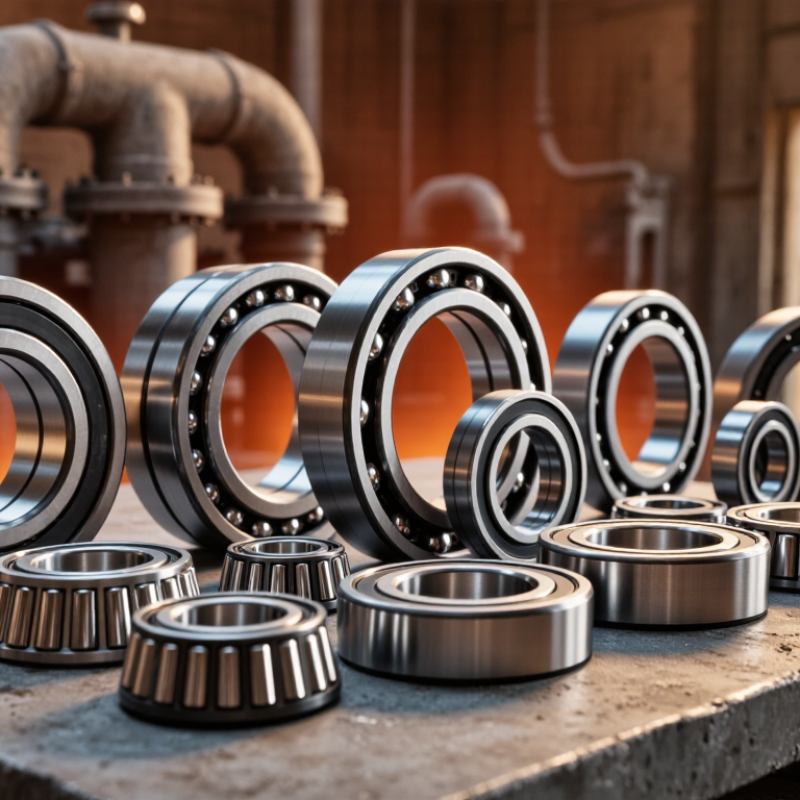
For moderate loads, heat-stabilized bearing steel is often a practical starting point. Specify its temperature rating, not just its hardness. Stainless steel may help where washdown or corrosion is expected, but its load capacity can differ. Hybrid ceramic rolling elements may reduce friction at high speed; they are not automatically better for impact loads. Retainer material matters too. Some polymer cages soften at elevated temperatures, so compare continuous-service limits with real operating conditions. There is no universal winner.
Lubrication often decides service life. Select grease by operating temperature, speed, load, and relubrication access. A high dropping point alone does not prove that grease will resist oxidation or stay in place. For dusty outdoor equipment, effective seals and clean relubrication practices matter as much as the lubricant itself. Use the bearing maker’s temperature and speed limits, then validate them with measured housing temperatures during commissioning. That check can expose a poor assumption early.
In Middle Eastern cement plants, kiln-support rollers face heat, heavy radial loads, and fine dust. Spherical roller bearings can accommodate shaft misalignment and demanding loads, but their lubricant and cage must suit the measured operating temperature. Heat-stabilized deep-groove ball bearings may fit smaller fans and pumps where loads are moderate and speeds are higher. Dust changes everything.
Steel reheat lines and industrial dryers often need cylindrical roller bearings for high radial loads and better stiffness. They are less forgiving of misalignment, so alignment checks matter. For slow, oscillating equipment near hot process zones, graphite-lubricated plain bearings can avoid grease breakdown. Their friction and wear still need assessment under the actual load and motion.
Desert solar-thermal equipment adds daily temperature swings, long operating hours, and exposure to airborne sand. Sealed designs can help keep contaminants out, though seals themselves have temperature limits. There is no perfect chart. A useful selection starts with bearing temperature, not just ambient air temperature, then checks speed, load, misalignment, and relubrication access. One assumption often fails: a bearing rated for high heat may still perform poorly when lubricant life, installation, or dust control is overlooked.
| Bearing type or arrangement | Indicative temperature range | Main advantages | Limitations and selection points | Common regional applications | Practical selection guidance |
|---|---|---|---|---|---|
| Standard steel bearing with conventional grease | Often suited to bearing temperatures up to about 80–120°C, depending on grease, seals, and relubrication. | Widely available; economical; suitable for many general-purpose motors, fans, and pumps. | Grease life can fall sharply as temperature rises. Standard seals and cages may not tolerate sustained heat. Dust and sand can accelerate wear if sealing is inadequate. | Building-services fans, general pumps, and motors in climate-controlled or moderate-temperature locations. | Use only when the measured bearing temperature and the grease and seal ratings are within their limits. Consider heat-stabilised components where temperatures exceed ordinary service conditions. |
| Heat-stabilised steel bearing with high-temperature grease | Commonly designed for roughly 120–200°C service; the actual limit depends on the bearing, grease, cage, and duty cycle. | Retains familiar rolling-bearing arrangements while improving suitability for elevated temperatures. Can be appropriate where routine relubrication is possible. | High-temperature grease may have shorter service life and higher friction. Grease suitability, relubrication interval, load, and speed must all be checked. | Cement-plant fans, hot-air handling equipment, industrial ovens, and process pumps near warm equipment. | Specify the required continuous and peak temperatures, speed, load, and relubrication method. Do not infer a temperature rating from the grease rating alone. |
| High-temperature bearing with solid lubricant | Some purpose-designed arrangements operate around 200–350°C; limits vary substantially with design, load, speed, and atmosphere. | Can avoid conventional grease at high temperatures and may suit slow-moving or intermittently moving equipment. | Often unsuitable for high speed or demanding lubrication conditions. Solid lubricant can affect friction, running-in, and allowable load; contamination may still be a concern. | Kiln cars, furnace doors, hot conveyors, and slow-speed equipment in cement, metals, and ceramics facilities. | Confirm the bearing is specifically designed for the application. Check speed, load, movement frequency, oxidation or process atmosphere, and maintenance access. |
| Oil-lubricated cylindrical or spherical roller bearing | Potentially suitable for approximately 150–250°C bearing temperatures in engineered systems; the practical limit depends on oil, seals, cage, and heat removal. | Circulating oil can lubricate and carry heat away. Roller designs can support substantial radial loads; spherical roller designs can accommodate misalignment. | Requires a reliable oil supply, suitable viscosity, filtration, and often cooling. Oil leakage, contamination, and system complexity need attention. | Large cement-mill drives, steel-processing equipment, heavy fans, and high-load process machinery. | Design the bearing and oil system together. Verify oil viscosity at operating temperature, flow, cleanliness, sealing, and shutdown protection. |
| Full ceramic bearing | Temperature capability is highly design-dependent; selected all-ceramic designs can serve duties beyond the range of conventional steel bearings. | Can resist corrosion and electrical current passage and may operate without conventional grease in selected applications. | Not a direct drop-in choice for every steel bearing. Load capacity, shock resistance, clearances, cage design, and thermal expansion require careful review. | Specialty chemical-processing equipment, electrically sensitive machinery, and selected hot or corrosive process applications. | Confirm ceramic material, raceway and rolling-element design, cage or cage-free construction, load, speed, thermal gradients, and lubrication requirements with the equipment designer. |
| Hybrid ceramic bearing (ceramic rolling elements, steel rings) | Temperature limit is generally governed by the steel rings, cage, lubricant, and seals rather than the ceramic rolling elements alone. | Can offer electrical-insulation benefits and lower rolling-element mass in suitable high-speed applications. | The ceramic elements do not make the complete bearing automatically suitable for extreme heat. Standard grease, polymer cages, and seals may set a much lower limit. | Selected electric motors and variable-speed drives where electrical-current damage is a concern and temperatures remain within component ratings. | Choose primarily for a defined electrical or speed-related need. Specify temperature-rated lubricant, cage, seals, and clearances as a complete assembly. |
| Sealed bearing with enhanced contamination protection | Temperature capability depends on the seal material and lubricant; many sealed arrangements are intended for moderate rather than extreme heat. | Helps exclude fine dust and sand and retain lubricant in exposed installations. | Seal friction can add heat, and many elastomer seals have temperature limits below those of the bearing steel. A tighter seal does not replace correct installation or maintenance. | Outdoor pumps, cooling-tower fans, conveyors, and equipment exposed to desert dust or windblown sand. | Balance dust exclusion against operating temperature and speed. Check seal material, ingress protection needs, shaft condition, and the site’s cleaning practices. |
Important: Bearing temperature is not the same as outdoor ambient temperature. Local heat, direct solar exposure, process temperature, speed, load, alignment, and lubrication can raise the bearing’s operating temperature. Treat all ranges above as screening guidance; confirm continuous and peak limits for the complete bearing assembly with the equipment designer or bearing supplier before specifying.
Selection, Installation, and Maintenance Criteria for 2026
Specify bearings from measured operating conditions, not the peak weather forecast alone. WMO’s State of the Climate in the Arab Region 2023 reports that the region is warming at nearly twice the global rate. Heat inside a pump or fan can rise further through load, poor airflow, and nearby hot surfaces. Record shaft speed, radial and axial loads, housing temperature, and start-stop frequency. Then check bearing material, internal clearance, cage limits, seals, and lubricant against the actual duty cycle. ISO 281:2007 provides basic rating-life calculations, but its assumptions do not capture every contamination or lubrication problem. A spreadsheet is useful; it can still miss a hot, dusty housing.
Installation sets the baseline. Clean the shaft and housing, confirm fits and alignment, and use controlled induction heating where appropriate. Never transfer mounting force through rolling elements. Too much heat can damage lubricant or seals; too little measurement can hide excessive clearance. For maintenance, log temperature and vibration after commissioning, then compare trends under similar loads. Inspect grease condition and replenishment intervals against the bearing maker’s technical limits, without assuming one interval suits every site. ISO 15243:2017 helps classify damage patterns, supporting more useful failure investigations.
Tips: Keep a dated temperature-and-vibration log. Recheck alignment after major repairs. If readings drift, investigate early; waiting for noise is often waiting too long.